What the official page showed
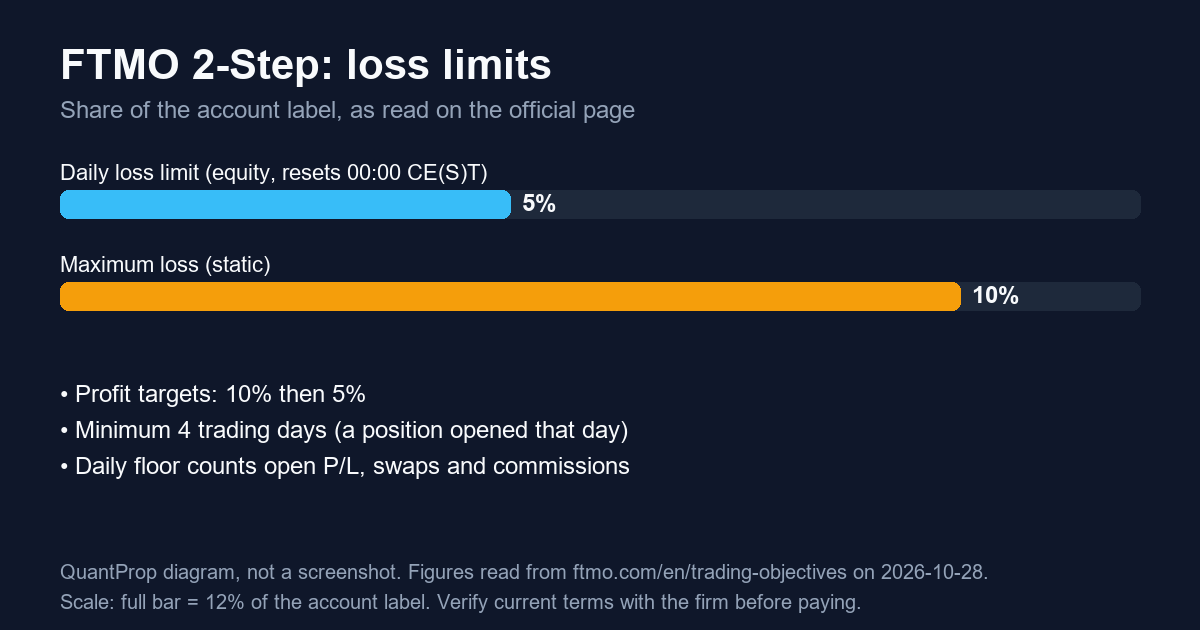
Product scope
Program reviewed: the Forex and CFD evaluation with its 2-Step and 1-Step variants. FTMO also sells a futures offering and, as of 2026-10-28, advertises an Instant Account in a banner on its site. Neither of those is covered here, so do not apply the numbers below to them. This is not a review of every account the brand sells.
Official rules, summarized
As of 2026-10-28, the 2-Step path asks for a 10% profit target in the first phase and 5% in the second. The 1-Step path asks for a 10% target. The loss rules matter more than the targets, because a breach ends the account at any point in the evaluation. Read the table first, then the detail in the next two sections. The 1-Step and 2-Step paths are different products. They share a name and a platform, but their loss limits and consistency rules do not match, so check the one you intend to buy.
The daily loss rule in detail
FTMO defines the Maximum Daily Loss as a floor under account equity, not under closed profit. Equity means balance plus open positions profit or loss, plus or minus swaps, minus commissions. If equity falls below the limit at any moment, the rule counts as violated, even if the trade would have recovered. The limit is recalculated each day at 00:00 Central European (Summer) Time. It is the day's starting balance minus the Maximum Daily Loss Amount, which is 5% of the Initial Simulated Capital on the 2-Step path. On the first trading day the starting balance is the initial capital. A worked example on a 100,000 account: the amount is 5,000. If the balance at 00:00 is 102,000, the floor for that day is 97,000. If the balance is 98,000, the floor is 93,000. The amount stays fixed in currency terms while the starting point moves with your results.
Maximum loss and trading days
On the 2-Step path the Maximum Loss is static at 10% of the initial capital. On a 100,000 account the floor is 90,000 and does not rise with profit, which makes it simple to model. The 1-Step path uses a trailing maximum loss measured at the end of the day, which behaves differently, so do not assume a static floor there. The 2-Step path also requires at least four trading days. A trading day counts when a position is opened between 00:00 and 23:59:59 Central European (Summer) Time. Opening a trade is what counts, so plan the days on which you can take a valid setup rather than forcing entries to reach the number.
Testing a strategy against these limits
Before paying, replay your own trades against the floors above. For each day, take the opening balance, subtract five percent of the initial capital, and mark the lowest equity reached during the day, not the closing balance. Do the same for the ten percent floor across the whole period. Include swaps and commissions, because the rule counts them. If the replay shows even one day that touches the floor, the strategy has no margin for error on this product. The drawdown tool can help with the arithmetic, and the guide on static versus trailing drawdown explains why the 1-Step and 2-Step results differ. For a side-by-side view, see the prop firm comparison hub.
Advantages
The 2-Step static maximum loss is easy to reason about because the floor never moves. The official rule definitions are detailed and include formulas, which makes it possible to rebuild the limits in a spreadsheet and test a trade history against them. FTMO also publishes the daily reset time, which removes one common source of disputes.
Limitations and risks
The equity-based daily limit is the main hazard. A position that dips below the floor and then closes green still counts as a breach, so wide stops and overnight swaps matter. The 1-Step trailing rule behaves very differently from 2-Step, and a 50% best-day consistency rule applies to relevant newer 1-Step accounts, which can delay a payout after one large winning day. The fee for the evaluation is not recovered if the account breaches. Treat it as expendable money. Terms can differ by product version and purchase date, so keep a dated copy of the rules you bought under.
Payout structure
As of 2026-10-27, the reward split on the 2-Step path is 80% by default and can reach 90%. The 1-Step path pays 90%. Reward requests are generally possible from day 14 after the first trade. Confirm the current split, the minimum request and the payment methods on FTMO's payout page before you rely on them, because they are product terms and can change.
Who might consider it?
A trader whose historical or paper-trading record shows the strategy staying inside a 5% daily equity floor and a 10% static floor, including open-trade drawdown and swaps. A swing strategy that holds through news with wide stops needs the most scrutiny. The evaluation fee should be treated as expendable, not as an investment with a promised return.
Red flags to check before paying
Does an intraday equity dip cause an immediate breach even if the trade closes green? Is the advertised account amount notional buying power rather than the available loss buffer? Can the firm change applicable terms by product version or purchase date? Are news-event trading and algorithmic execution allowed on the product you will buy? Does your country appear on the eligibility list?
Important exception
Review the 1-Step and 2-Step paths independently, and verify jurisdiction and product-specific news and automation restrictions on the firm page before paying.
Bottom line
Do not choose from account size or the advertised reward split alone. Compare the effective risk budget, reset cost, rule complexity and reachable payouts under your own trading distribution. For FTMO, the questions that decide it are whether your open-trade drawdown stays above the daily floor and which path you are buying.
How this was sourced
Rules were read from FTMO's official trading objectives page in a browser on 2026-10-28, and QuantProp drew its own diagram from those figures. Payout details come from the editorial pack of 2026-10-27 and FTMO's payout FAQ. Promotions, fees and eligibility change, so verify before purchasing. QuantProp did not open an account or test a payout.
Editorial disclosure
QuantProp has no verified commercial relationship with FTMO or any other firm discussed here. This is an independent rules summary, not an endorsement or proof of payout reliability. No affiliate links are active. Trading evaluations involve fees and a substantial risk of failure.
Revision log
2026-10-28: imported from the editorial pack dated 2026-10-27; approved for publication by the owner. 2026-10-28: Expanded from the pack summary after reading FTMO's official trading objectives page in a browser on 2026-10-28: added the captured Maximum Daily Loss panel, a rules table, a worked daily-loss example, six Q&A entries and a source list. The pack's numbers were not changed; the 1-Step consistency rule and payout split were not re-read and stay as of 2026-10-27. Replaced the captured screenshot with an original QuantProp diagram because the right to publish the firm's image was not confirmed.
At a glance
| Rule | 2-Step | 1-Step |
|---|---|---|
| Profit target | 10% in phase one, 5% in phase two | 10% |
| Maximum daily loss | 5% of initial capital, equity based | 3% of initial capital |
| Maximum loss | 10% of initial capital, static | 10% trailing, end of day |
| Minimum trading days | 4 days with an opened position | Check the 1-Step page |
| Best-day consistency | Not stated for 2-Step | 50% cap on newer accounts |
| Reward split | 80% by default, up to 90% | 90% |
Frequently asked questions
What is the FTMO daily loss limit?
On the 2-Step path it is 5% of the initial simulated capital, measured against account equity and recalculated at 00:00 Central European (Summer) Time from that day's starting balance. The 1-Step path states 3%. Check the page for your product version.
Is the FTMO maximum loss static or trailing?
On the 2-Step path it is static at 10% of the initial capital, so the floor does not move as you profit. On the 1-Step path it trails at the end of each day, which changes how much room you keep after a winning stretch.
Does an open trade count toward the FTMO daily loss?
Yes. FTMO measures equity, which includes open positions profit or loss, swaps and commissions. A temporary dip below the floor counts as a breach even if the trade later closes in profit.
How many trading days does the FTMO 2-Step require?
At least four. A day counts when a position is opened between 00:00 and 23:59:59 Central European (Summer) Time, as of the page read on 2026-10-28.
What is the FTMO profit split?
As of 2026-10-27, the 2-Step default is 80% with the possibility of 90%, and the 1-Step pays 90%. Confirm the current split and eligibility for payout requests on FTMO's payout page.
Does this FTMO review use affiliate links?
No. No affiliate link, coupon or sponsored placement is active on this page, and QuantProp has no verified commercial relationship with FTMO. Links to the firm go to its official pages only.