What the official page showed
Product scope
Program reviewed: the futures Trading Combine and the Express Funded Account that follows it, plus the Live Funded Account stage described on the payout page. Topstep also sells other programs and add-ons that are not reviewed here. Verified facts are as of 2026-10-28.
Official rules, summarized
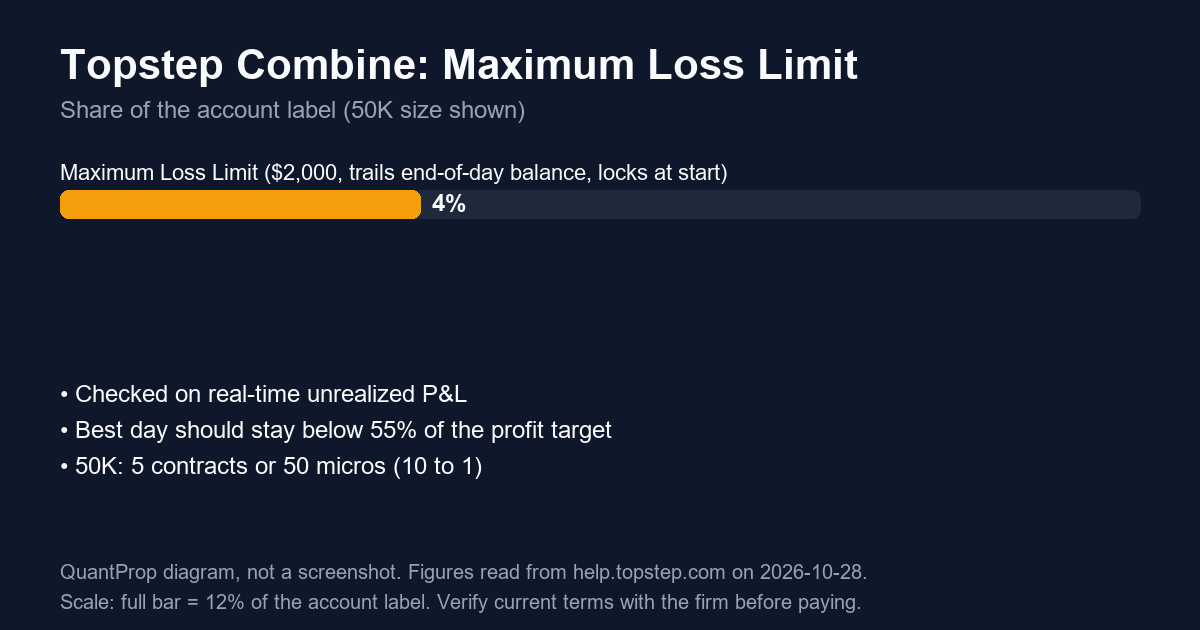
Topstep describes the Trading Combine as a simulated account with one rule and two objectives. The rule is not to let the account balance reach the Maximum Loss Limit. The objectives are to reach and maintain the profit target and to meet the consistency target, which means the best single day should stay below 55% of the profit target. Position size is capped by account size. The 50K account allows 5 contracts or 50 micros, the 100K allows 10 and 100, and the 150K allows 15 and 150. Micros and minis count at a 10 to 1 ratio, and trading fewer contracts is always allowed.
How the Maximum Loss Limit works
The limit is $2,000 on the 50K size, $3,000 on the 100K and $4,500 on the 150K. It is a trailing floor. It rises as the end-of-day balance grows and never moves down, and once it reaches the starting balance it locks permanently. The floor is checked against real-time unrealized P&L. If an open loss touches the limit during the day, the system closes the position with a market order and the liquidation stands, even if the trade would have recovered. Slippage on that exit can land slightly above or below the limit. A worked example from the official page: a 50K Combine starts at a 50,000 balance with the limit at 48,000. A 500 profit lifts the balance to 50,500 and the limit to 48,500. A 500 loss the next day returns the balance to 50,000 while the limit stays at 48,500, so the usable room has shrunk from 2,000 to 1,500.
The Express Funded Account
In the Express Funded Account the balance starts at zero, and the 50K, 100K or 150K label refers to buying power. A 50K account starts with the limit at minus 2,000, trails upward and locks at zero once the balance reaches 2,000. After the first payout the limit is set to zero regardless of where it was, so the remaining balance becomes the effective loss floor. This is why the label can mislead. A 50K label does not mean 50,000 of freely withdrawable capital or a 50,000 loss budget. The real loss budget is the limit, which is 2,000 on that size.
Payout structure
Topstep states a 90/10 profit split, a minimum payout of 125 dollars, and two paths in the Express Funded Account. The Standard path needs five winning days of at least 150 dollars net P&L and no consistency test. The Consistency path needs three trading days with at least one trade each and a largest day no higher than 40% of total net profit. Each request is up to 50% of the account balance, capped by size and path as shown in the second table. The page also states that traders who joined the new dashboard before 2026-01-12 receive 100% of their first 10,000 dollars of lifetime profit. After a payout the limit resets to zero and the day count restarts. Live Funded payouts are not capped, and daily payouts open after 30 winning days there.
Payout methods and fees
Processing varies by method. The page lists same-day prop-to-brokerage payouts for US traders, Aeropay for US banks, Wise for China, Canada and the United Kingdom, ACH, and international wire. ACH and wire carry a 30 dollar fee as of this check. The page's own example shows that a 500 dollar ACH request returns 420 dollars after the 10% split and the fee. Internal approval can take one to three business days.
Advantages
The rulebook is short. There is one loss rule, and the official pages give formulas and worked examples, so a trader can reproduce the floor in a spreadsheet. The Combine, Express and Live stages are separate and documented, and the payout page states caps, methods and fees openly.
Limitations and risks
The trailing floor is the main hazard. Because it follows the end-of-day balance upward, a good week reduces the room you have left, and an intraday swing can liquidate the account before any recovery. The per-request payout caps are small relative to the account label, and the Combine carries a monthly subscription that keeps charging while you trade. Rules change, and the page notes limited-time offers, so keep a dated copy.
Testing a strategy against these limits
Replay your trade history with intraday marks. Start the floor at the starting balance minus the limit, raise it by each profitable end-of-day balance, and flag any day where open equity touches it. Then check that your largest day stays below 55% of the target. The drawdown tool helps with the arithmetic, and the guide on static versus trailing drawdown explains why this structure behaves differently from a fixed floor. For other firms, see the prop firm comparison hub.
Who might consider it?
A trader whose futures record shows controlled intraday drawdown and a profit profile spread across many days. Strategies that rely on one large winning day or that hold losing trades through volatility are the weakest fit. Treat the fee as expendable, not as an investment with a promised return.
Red flags to check before paying
Does an open loss that touches the floor close the account even if the trade would recover? Is the account label buying power rather than a loss budget? Which country and citizenship rules apply to live funded access? What are the monthly subscription, reset and data fees? Are copy trading and automation allowed on your exact account? Do the payout caps suit the income you expect?
Important exception
Check both citizenship and permanent residence. Live account availability and payout methods vary by country, and the payout page lists regions where methods are not available.
Bottom line
Do not choose from account size or the advertised split alone. Compare the effective risk budget, the reset cost, the payout caps and the rule complexity under your own trading distribution. For Topstep, the deciding question is whether your open-trade drawdown stays inside a trailing floor that is only a few percent of the label.
How this was sourced
Rules and payout details were read from three Topstep Help Center articles in a browser on 2026-10-28, and QuantProp drew its own diagram from those figures. Eligibility details come from the pack of 2026-10-27 and were not re-read. QuantProp did not open an account or test a payout.
Editorial disclosure
QuantProp has no verified commercial relationship with Topstep or any other firm discussed here. This is an independent rules summary, not an endorsement or proof of payout reliability. No affiliate links are active. Trading evaluations involve fees and a substantial risk of failure.
Revision log
2026-10-28: imported from the editorial pack dated 2026-10-27; approved for publication by the owner. 2026-10-28: Expanded after reading three Topstep Help Center articles in a browser on 2026-10-28 (Trading Combine parameters dated 2026-09-25, Maximum Loss Limit dated 2026-09-19, Payout policy). Added the captured Maximum Loss Limit table, a rules table, worked examples, Q&A and a source list. Corrected the pack: payout caps are now stated per account size, and the optional Daily Loss Limit add-on is described. Replaced the captured screenshot with an original QuantProp diagram because the right to publish the firm's image was not confirmed.
At a glance
| Account | Maximum Loss Limit | Max contracts | Max micros |
|---|---|---|---|
| 50K | $2,000 | 5 | 50 |
| 100K | $3,000 | 10 | 100 |
| 150K | $4,500 | 15 | 150 |
| Item | Standard path | Consistency path |
|---|---|---|
| Requirement | 5 winning days of $150+ net P&L | 3 trading days and a 40% consistency target |
| Request size | Up to 50% of balance, capped | Up to 50% of balance, capped |
| Cap on 50K | $2,000 | $3,000 |
| Cap on 100K | $3,000 | $4,000 |
| Cap on 150K | $5,000 | $6,000 |
| Profit split | 90/10 | 90/10 |
Frequently asked questions
What is the Topstep Maximum Loss Limit?
It is the lowest balance the account may reach: $2,000 below the start on the 50K Combine, $3,000 on the 100K and $4,500 on the 150K. It trails the end-of-day balance upward and never moves down.
Does Topstep count open losses toward the limit?
Yes. The limit is calculated on real-time unrealized P&L. If an open loss reaches the threshold, the position is closed by market order and the liquidation stands even if the trade would have recovered.
What is the Topstep consistency target?
In the Trading Combine, the best single day should stay below 55% of the profit target to avoid raising the target. In the Express Consistency path, the largest day cannot exceed 40% of total net profit.
What profit split does Topstep pay?
The payout page states a 90/10 split with a $125 minimum request. Traders who joined the new dashboard before 2026-01-12 receive 100% of their first $10,000 of lifetime profit, then 90/10.
How much can I withdraw per Topstep payout?
Up to 50% of the account balance, capped in the Express stage. On a 50K account the cap is $2,000 on the Standard path and $3,000 on the Consistency path. Live Funded payouts are not capped.
Does this Topstep review use affiliate links?
No. No affiliate link, coupon or sponsored placement is active on this page, and QuantProp has no verified commercial relationship with Topstep. Links to the firm go to its official pages only.